
Which Riverside Records Are Open
Public access in Riverside follows the custodian that made or received the record. The City of Riverside handles its own council, contract, permit, and department files. Riverside County offices hold countywide land, clerk, health, and custody material. The Superior Court is a separate branch, and state agencies control statewide license, prison, and business indexes. The table gives the first access point and flags where a public index is not the same as an unrestricted copy.
| Riverside record group | Office that keeps it | Online starting point | How access works |
|---|---|---|---|
| Deeds, liens, and clerk filings | County Assessor-County Clerk-Recorder | Official Records Search and Copies | Free index; paid plain or certified copies; older books at an office |
| Parcels and assessor maps | County Assessor | RivCoView and Assessor Maps | Public address or APN search; map PDFs are free |
| Civil, criminal, traffic, family, and probate cases | Riverside Superior Court | Public Access | Account required; case-number search free; name and document access may cost |
| Birth, death, fetal death, and marriage | RUHS, County Clerk-Recorder, or CDPH-VR | eVitals or copy application | No open name index for most certificates; copy type and eligibility control access |
| City and county agency files | City department or county department | City Records Portal or County NextRequest | California Public Records Act request, subject to exemptions |
| Current jail and state prison custody | County Sheriff or CDCR | Inmate Information System or CIRIS | Public status lookup, not a full criminal-history file |
Some records remain closed or partly withheld. Riverside requesters should expect limits for sealed and juvenile cases, adoption files, confidential marriages, protected voter data, motor-vehicle records, Safe at Home addresses, and material made confidential by another law. Court access is also limited by California Rules of Court 2.501 and 2.503. A redacted response can still disclose the part that state law permits.
Riverside Recorder Index Access
The Official Records Search and Copies portal offers name, document-number, document-type, map book/page, and advanced search paths. Recorder documents are indexed online from January 1, 1974 through July 8, 2026, while clerk documents run from January 1, 1893 through May 29, 2026. Those endpoints reflect the source inspection date, so a live portal may now extend farther. A party name points to a filing, document number, type, and recording date; the ordered copy is the record itself.
The Riverside recorder name-search screen shows both coverage notices and the last-name-first rule used for individuals.
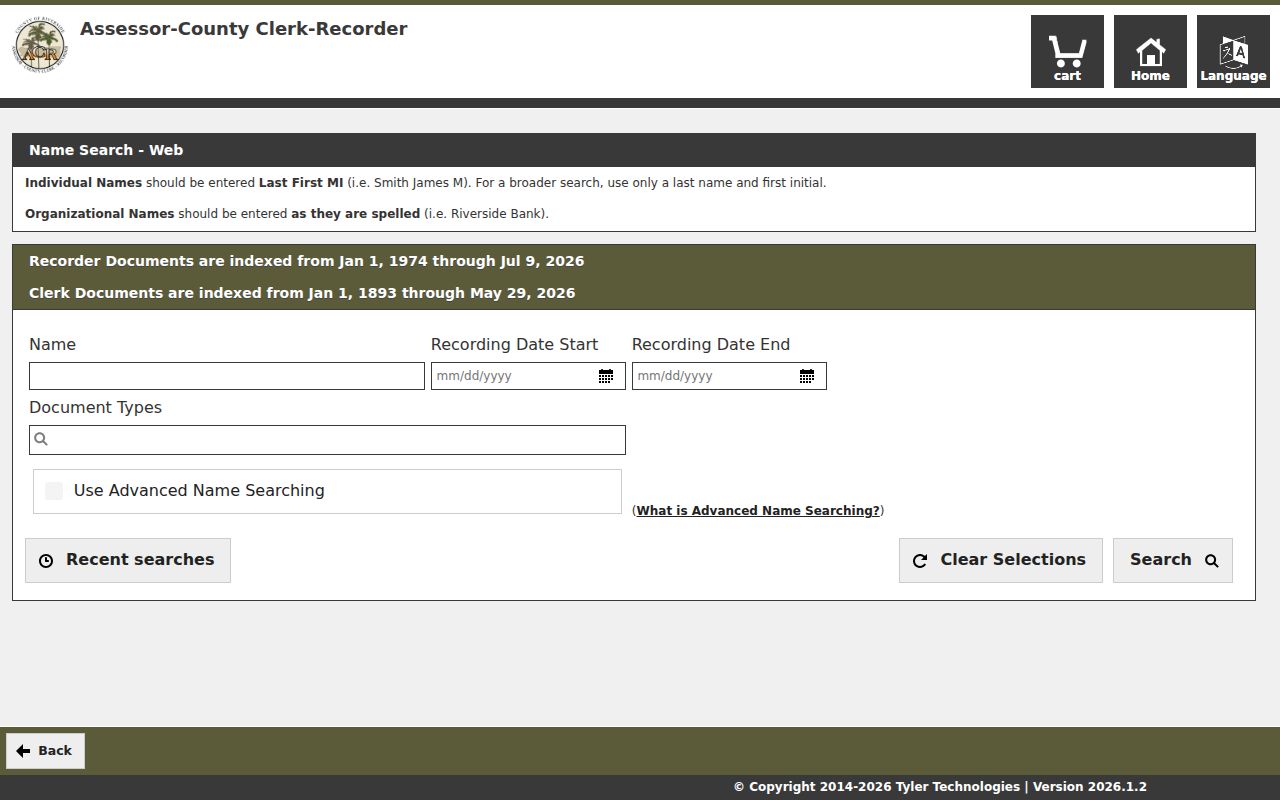
That format matters for compound surnames and initials because a broad first attempt can miss a valid indexed party.
| Portal control | Input kind | Required? | Riverside format or use |
|---|---|---|---|
| Name | Text | Primary on name search | Individual: Last First MI; organization: name as spelled |
| Recording Date Start | Date | Optional | Lower end of the filing-date range |
| Recording Date End | Date | Optional | Upper end of the filing-date range |
| Document Types | Multi-select | Optional | Limits the search by filing type |
| Document Number | Text | Optional in advanced search | Also has its own direct search mode |
| Map Type and Book/Page | Structured fields | Optional | Separate map-record path |
| Advanced Name Searching | Rules option | Optional | Exact, wildcard, phonetic, uncertain-letter, fuzzy, grouping, AND/OR |
The advanced Riverside official-record search places the name, date, number, and document-type controls in one form.
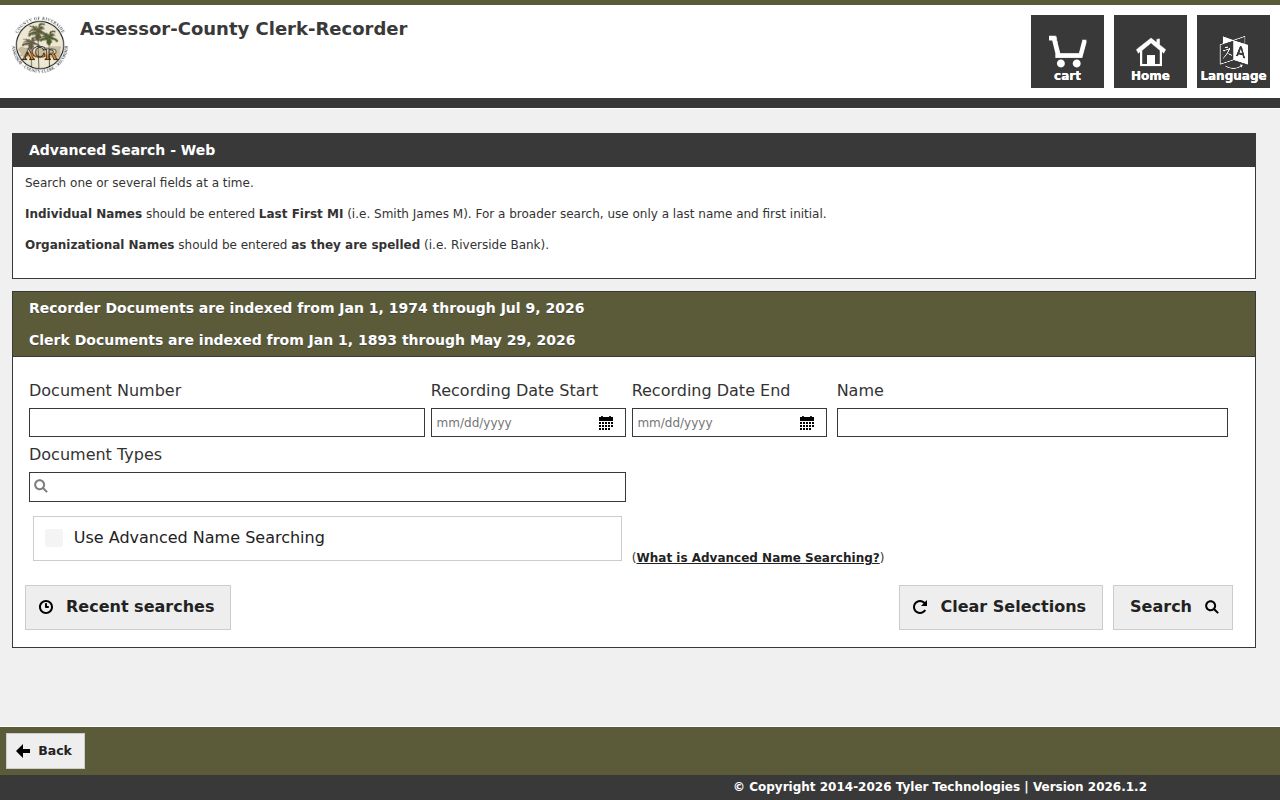
Combining fields is useful when a common name yields too many Riverside filings.
Riverside Names Beyond One Spelling
The recorder's search grammar is a rare practical strength. Exact matching expects the surname first and no punctuation. Wildcard mode treats order more loosely. The portal documents a dollar sign for sounds-like searching, a question mark for a possibly wrong letter, an asterisk for starts-with terms, a tilde for fuzzy or proximity searching, and plus or minus signs for terms that must or must not appear. Parentheses, quotes, and OR logic can further shape a query.
This is useful in Riverside records with initials, Spanish compound surnames, old spellings, or indexing errors. Start with the form printed on a known deed or certificate, then test a surname and first initial, a phonetic form, and one uncertain character. Keep the recording date and document type broad until the likely party appears. Narrow only after the index shows too many matches.
Note: A blank first search does not prove that Riverside County lacks the record; spelling, coverage, and office channel may be the cause.
Older Riverside Record Books
Online coverage is not the end of the Riverside recorder trail. County instructions say records back to 1975 can be searched on computers at any Assessor-County Clerk-Recorder office. Records from 1974 and earlier must be searched at the Gateway Riverside location. That fallback is especially important for an old deed chain, easement, lien, map, or family-history question whose first filing predates the web index.
Copies are available online, in person, or by mail. Riverside County lists online processing at 48 hours. Searchers who need an early book should bring names, an approximate year, document type, and any book/page or legal-description reference already known. A staff member can route the search, but the request is much more precise when it names a record series instead of asking for every file tied to a person.
The county's official-record copy instructions explain the online, counter, mail, and pre-1975 paths.
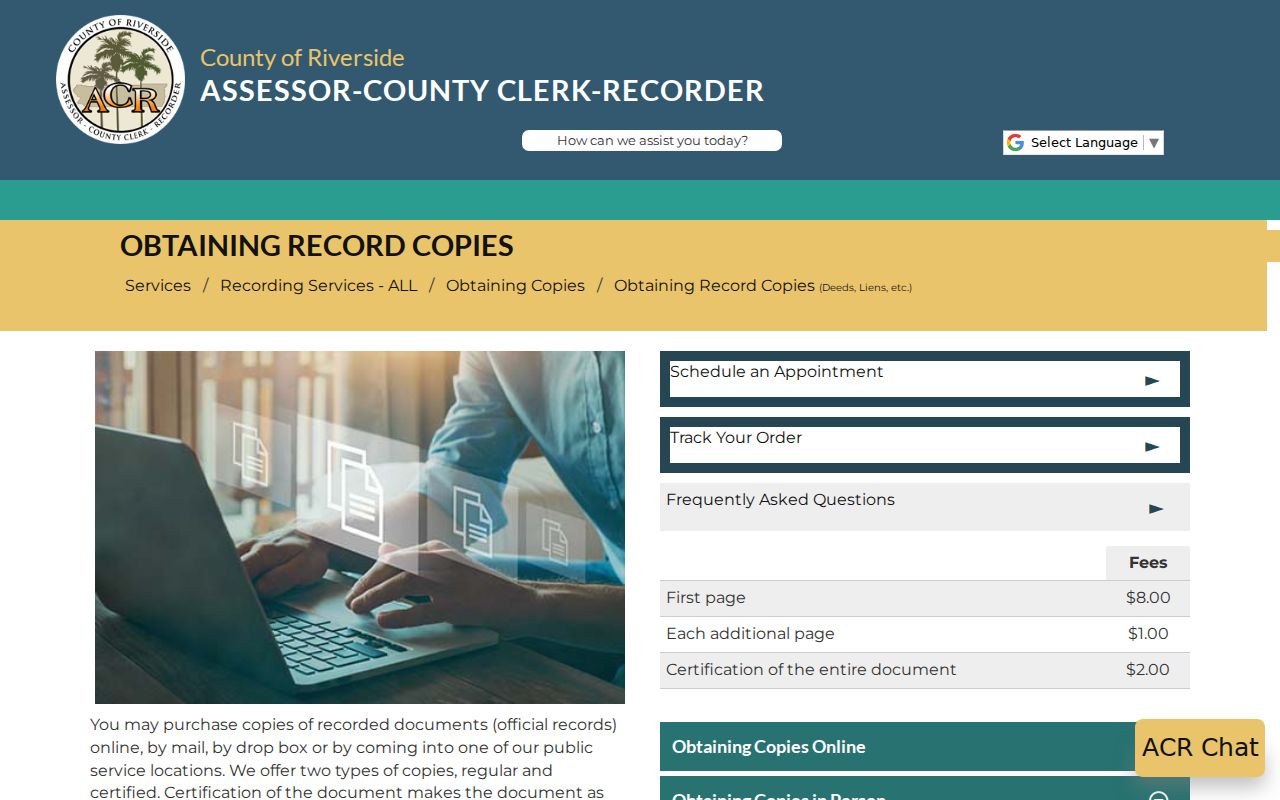
The page turns a failed online search into a clear office fallback instead of a dead end.
Riverside Records Custodians
Riverside is both an incorporated city and the county seat. A city address can produce city permits while the same parcel's deed remains a county record. County offices also serve communities far beyond Riverside city limits. Choose the card by record type, then confirm the event or property belongs in that jurisdiction. Published phone hours for the Assessor and Clerk-Recorder are 8:00 a.m. to 5:00 p.m., Monday through Friday.
County Assessor
Parcel data, values, and assessor maps
(800) 746-1544
(951) 955-6200
County Clerk-Recorder
Recorded documents, clerk filings, marriage, and older certificates
(800) 696-9144
(951) 486-7000
RUHS Vital Records
Current and prior-year county birth, death, and fetal-death copies
County health custodian
RUHS Office of Vital Records
Riverside Superior Court
Civil, criminal, traffic, family, and probate case files
Separate judicial custodian
Court locations and services
Agency files that do not fit a specialized portal go to the city or county request system. Vital certificates, court files, voter data, and recorder copies stay with their own custodians even when the request concerns Riverside.
Riverside Property Record Channels
RivCoView accepts a Property ID Number, also called a PIN or APN, or a property address. The portal instructs users to enter a nine-digit APN without dashes and to use street number plus street name for an address. The research did not confirm a public owner-name field, so it would be wrong to promise one. A result can produce map and property-report material, while the recorder holds the deed that documents a transfer.
The Riverside County Assessor Maps page offers parcel-map PDFs and explains what they do not show.
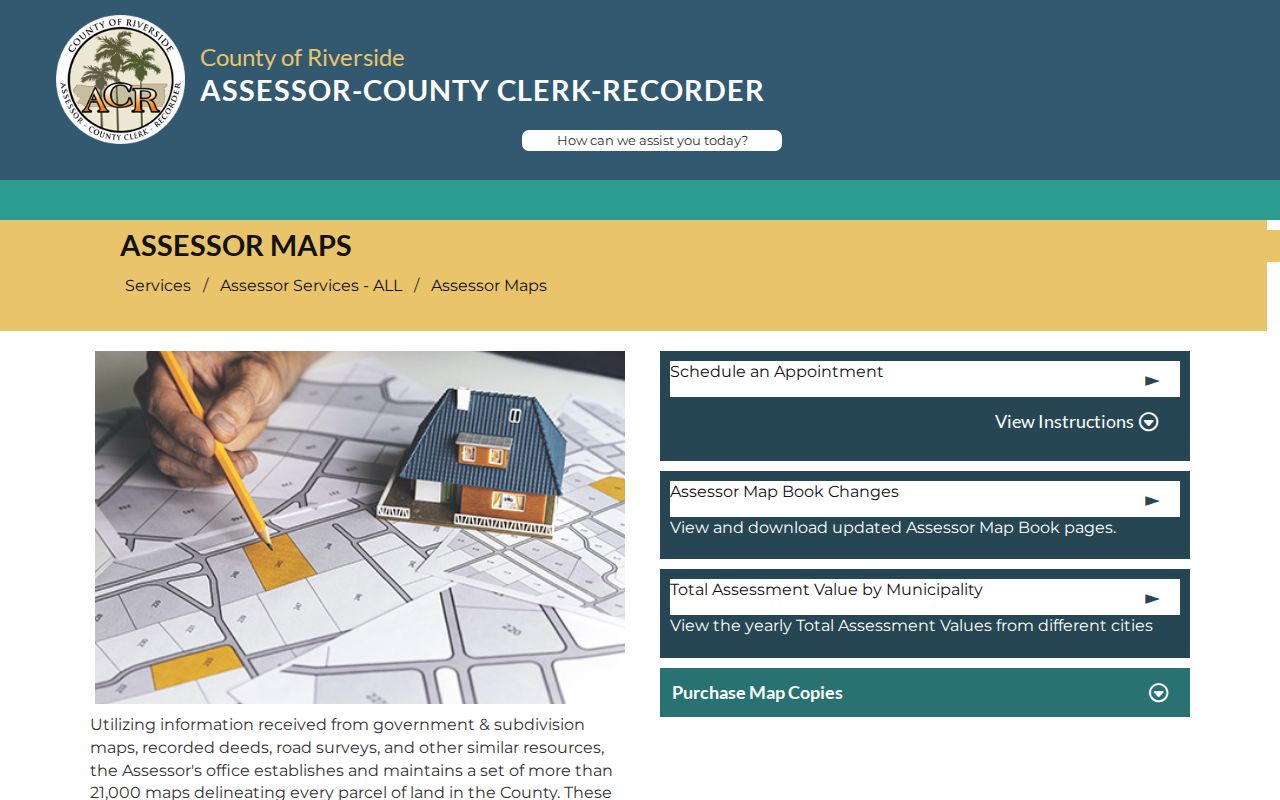
Those maps show parcel numbers, lot and parcel boundaries, recorded dimensions, acreage, street widths, adjoining parcels, and map references, but not street addresses or ownership.
Use Map My County for county GIS layers and APN map context. The City of Riverside's own GIS viewer helps test city limits. This geographic check matters because a Riverside mailing address can fall outside the incorporated city, shifting a building-file request from the city to Riverside County.
Riverside Building File Requests
Building records follow jurisdiction as well as address. The City of Riverside Building & Safety division creates permit, plan-review, and inspection records for city projects. County files outside that system use the Riverside County archived building-record request. The county form requires at least an address or APN and also asks for the requester's name and phone number; a company field is optional. It can be submitted online or printed.
The county archive form shows the address and APN paths used to identify the site.
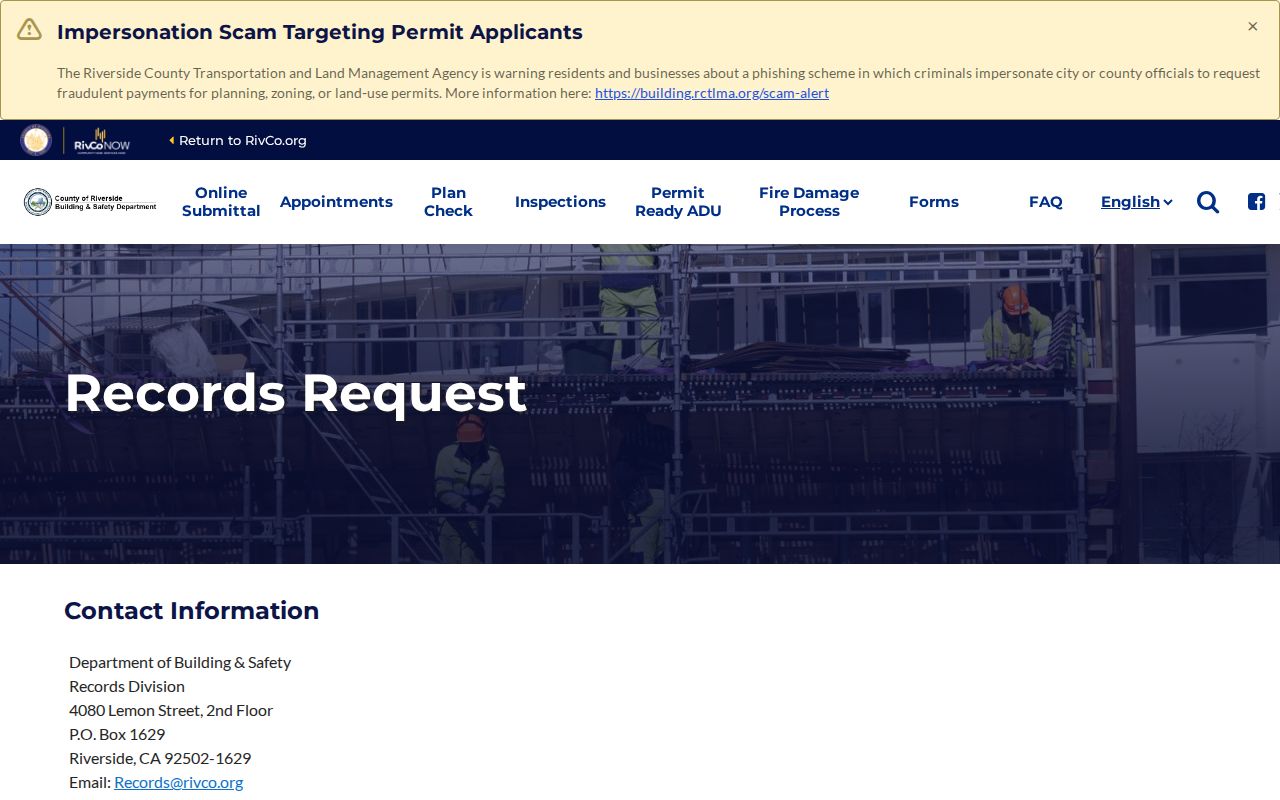
Riverside County warns that copies or archive research may carry a fee and says staff will contact the requester when research is complete.
For city permits without a public result, use the City Records Portal. For a county parcel, use the archived request rather than a broad County NextRequest filing. Supplying the APN, address, permit type, and approximate date helps the custodian find the right folder.
Riverside Court Record Access
The Superior Court Public Access overview separates court records from county executive files. The portal requires an account. A complete case number supports a free search and can return the register of actions. Civil and criminal or traffic name searches use paid credits. A name match returns case numbers and filing dates, while available documents can have separate download charges.
The Riverside court access page states the account, fee, and online-access limits.
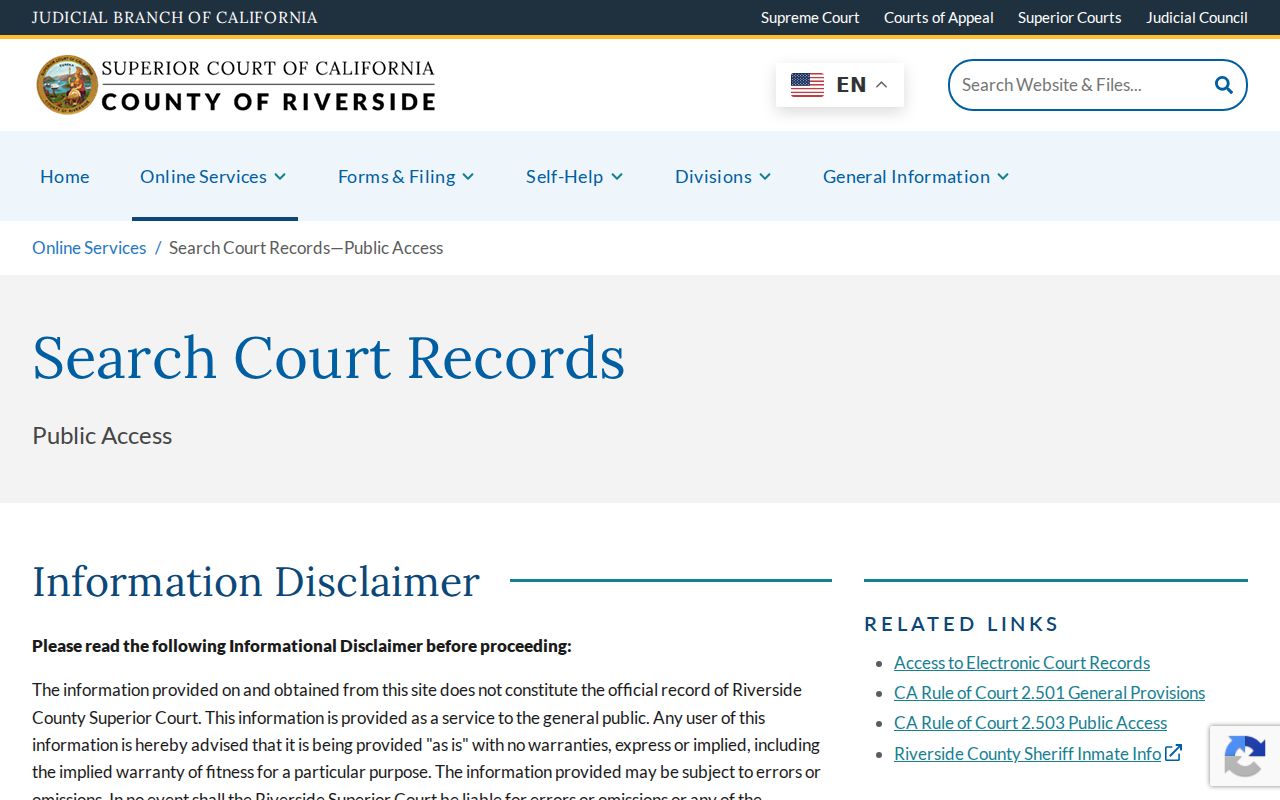
It also makes clear that portal information is not the official Riverside Superior Court record.
Name credits are listed at $1 for one, $3.50 for five, $5 for ten, $25 for 75, or $250 for 30 consecutive days of unlimited name searches. Once a name is found, up to ten cases for that name may be viewed before another name search is needed. The register of actions lists filed documents, filing dates, and the filing party. Calendars show current or future settings up to seven days, and probate notes have their own timing rules.
Note: Sealed, juvenile, adoption, and other confidential case material will not become open merely because a name appears in an index.
Riverside Vital Record Copies
Riverside certificate access turns on event type, year, county, and copy class. RUHS Public Health registers county births, deaths, and fetal deaths and issues current and prior-year copies. At the July 2026 inspection, eVitals handled 2025 and 2026 events and directed 2024 or earlier copies to the County Assessor-County Clerk-Recorder. CDPH-VR is the statewide route, while the county can issue only records for events in Riverside County.
California Health and Safety Code section 103526 distinguishes an authorized certified copy from an informational certified copy. The authorized version can establish identity and is limited to eligible requesters; a mailed request may need a notarized sworn statement. The informational version cannot establish identity and bears that legend. RUHS listed $34 for birth, $26 for death, and $23 for fetal-death certificates, plus a $1 copying fee per order and a 2.30 percent card convenience fee. A failed search does not make the search fee refundable.
Public marriage records come from the recorder where the license was issued. Confidential marriage records come only from that county's clerk. A certified divorce decree comes from Riverside Superior Court, not the recorder or RUHS. These custody lines prevent a common but costly request sent to the wrong desk.
Copy eligibility matters. An informational certificate is not valid to establish identity, and an authorized copy may require proof of eligibility and identity.
Riverside Custody Status Records
The Riverside County Sheriff Inmate Information System is a current custody lookup, not a complete case or criminal-history search. Last Name is mandatory. First Name and Date of Birth are optional, and the form says to enter as much information as possible. Use the court separately for filed cases and the sheriff's Corrections Operations pages for facility, mail, and visiting information.
For state prison custody, CDCR CIRIS may show the person's name, CDCR number, age, current location, commitment county, admission date, and parole-hearing information. California's Megan's Law registry displays only registrants and offenses that Penal Code section 290.46 permits the state to disclose. Some registrants do not appear publicly, and the registry cannot stand in for a full criminal record.
VINE offers custody-status notices as a free and confidential notification service. Each tool answers a different question: current county custody, current state custody, legally disclosable registry status, or notification. Treating them as one database can lead to false conclusions.
Riverside Records Terms Defined
Riverside offices use a few terms that explain why a free search result may not be enough. The index helps identify a record. A copy reproduces it. Certification adds an official statement about the copy, but it does not make closed content public.
- Custodian
- The agency or court responsible for keeping and producing a specific record.
- Index
- A list of names, dates, case or document numbers, and record types used to locate the underlying file.
- Image or copy
- A reproduction of the filed document, sometimes available only after payment or staff review.
- Certified copy
- A copy carrying the custodian's formal certification for an official purpose.
- Exemption
- A legal ground for withholding all or part of a requested record.
Grantor means the party transferring an interest in a recorded deed, while grantee means the party receiving it. A docket or register of actions is the court's dated list of filings and events, not necessarily the full set of readable documents.
Request Riverside Public Records
The California Public Records Act, Government Code section 7920.000 and following, lets any person ask a state or local agency for non-exempt records. The agency generally must decide within ten calendar days whether responsive, disclosable material exists. Unusual circumstances allow a written extension of up to fourteen more days. The deadline is for the determination, not a promise that every large production will be complete on that date.
Use the City of Riverside Records Portal for city department files and Riverside County NextRequest for county executive departments. NextRequest itself routes certificates, building permits, and other specialized material to their own channels. Courts are not county departments. Send court-file requests to Riverside Superior Court, recorder copies to the Clerk-Recorder, and vital-copy applications to RUHS, ACR, or CDPH as the event requires.
- Name the custodian. Decide whether the file belongs to the city, county, court, health office, or state agency.
- Check the existing index. Save a case number, document number, APN, date range, or other identifier if the portal provides one.
- Describe existing records. State the record type, office, subject, and a useful date range. Ask for an electronic copy when that format will work.
- Use the right channel. Submit through the specialized form, City Records Portal, County NextRequest, mail, or counter documented by the custodian.
- Review the response. Pay lawful copy or certification costs, narrow an overbroad request if useful, and ask for the legal basis of any withholding.
California agencies generally may charge direct duplication costs, not ordinary search and review time, unless a specific law permits more. The recorder has its own schedule: $8 for the first page, $1 for each added page of the same document, and $2 per document for certification. Once recorder copies are made, the portal says the fee is charged and no refund is issued. A CPRA denial may be challenged in Superior Court by writ or related court relief; California has no general administrative FOIA appeal office.
Lawful personal use. Use Riverside public records for legitimate civic, family-history, estate, property, or safety research. Never use a name, address, image, or status result to stalk, threaten, harass, impersonate, or harm anyone.
Riverside Privacy Boundaries
Official access does not erase privacy law. California Safe at Home supplies a substitute mailing address to eligible people who fear for their safety, and state and local agencies must accept that designated address. Confidential voter records are withheld, and voter files are limited to election, scholarly, journalistic, political, or governmental purposes. The full treatment of that record set belongs with Riverside voter records.
A separate 2026 change affects private data brokers rather than government custodians. California residents could begin using DROP on January 1, 2026 to send one deletion request to all active registered brokers. Those brokers were required to begin processing DROP requests on August 1, 2026 and to check the mechanism at least once every 45 days, subject to limited exceptions. That process does not delete a lawful deed index, court docket, or agency record from its official source.
Public filings may still expose names, signatures, addresses, legal descriptions, and transaction history. Protected identifiers should be redacted when law requires it. Verify any record with its Riverside custodian before relying on it, especially when the online item is only an index or status snapshot.